
































Business
Dee Hock, Credit Card Visionary, Is Dead at 93



Dee Hock, a banker with a junior college degree who shaped the Visa credit card into a global financial behemoth, died on July 16 at his home in Olympia, Wash. He was 93.
His son David confirmed the death.
The credit card business was in an early, rocky stage of development in 1966 when Mr. Hock was named to run the credit card department of National Bank of Commerce in Seattle, which was licensed by Bank of America to issue its BankAmericard.
At the time, the business was beset by bad debts and fraud, and the cards themselves were primitive: They lacked the magnetic stripes that would later encode customer information; transactions that required bank authorizations took a long time; and the embossed information on them — customer name, card number, expiration date — was awkwardly copied onto receipts with a heavy imprinter.
“By 1968, I was extremely concerned that the industry may go under and our bank’s investment with it,” Mr. Hock told Plazm, an arts and politics magazine based in Portland, Ore., in 2013. “I was attending a meeting of all of the licensees of BofA, which soon became a shambles of argument and accusations.”
He became the leader of a committee of bankers whose institutions licensed the BankAmericard, which was first issued in 1958. The panel’s mission: to determine the card’s future. (The American Express card made its debut that same year; eight years earlier, Diners Club had issued what is widely consider the first credit card.)
The committee’s solution was to create a new company, National BankAmericard, to be separate from Bank of America and to be controlled by the banks that issued the card. Mr. Hock was named president and chief executive. In 1976, after an in-house contest, the company was renamed Visa.
As chief executive, he oversaw the development of the first electronic authorization system and the first interbank electronic clearing and settlement system. Banks would issue the cards, not Visa, and they were mandated to add the magnetic stripe to their cards.
“Dee Hock realized something in the late 1960s that few others really understood: Computers and telecommunications would soon make it possible to build a global ‘electronic value exchange’ system that would soon enable customers to pay for goods and services ‘anywhere you want to be,’” David Stearns, the author of “Electronic Value Exchange: Origins of the VISA Electronic Payment System” (2011), wrote in an email. (The company renders its name in all capital letters.)
In a tribute, Alfred Kelly Jr., the chief executive of Visa, wrote that Mr. Hock had had a vision of “a world of frictionless commerce where anyone, anywhere could exchange value 24 hours a day, seven days a week, with absolute reliability.”
That vision, long since realized, has made Visa the world’s leading credit card network, with 3.9 billion cards issued and a total purchase volume of $13 trillion.
“What he did was undeniable: He made credit cards work,” Joe Nocera, a former New York Times columnist who wrote about Mr. Hock in his book “A Piece of the Action: How the Middle Class Joined the Money Class” (1994), said in a phone interview. “He took a system on the brink of collapse and said, ‘Follow me, I’ll take you to the promised land.’”
Dee Ward Hock ws born on March 21, 1929, in North Ogden, Utah. His father, Alma, was a utility lineman. His mother, Cecil (Dawson) Hock, was a homemaker.
As a boy, Dee became enamored of the biology and ecology around him in rural Utah, but he followed a banker’s career track after graduating in 1949 from the two-year Weber State College (now University) in Ogden.
Over the next 17 years, Mr. Hock was the manager of two branches of the bank Pacific Finance; an assistant manager of public relations and advertising for Pacific; general manager of the Columbia Investment Company; and a supervisor at CIT Financial (now Group). He was hired by National Bank of Commerce in 1966. But before joining it, he had “essentially retired on the job,” his son said in an interview.
“When people left him alone, he was usually the most successful part of the organization,” David Hock added. “But when they wanted to fix it, they usually messed it up.”
Energized by his work at Visa, Mr. Hock moved the company into offering fdebit cards, which gave cardholders access to checking accounts, as well as a premium card and a money-market fund.
“Mr. Hock is a magnificent strategist, maybe even brilliant,” Helene Duffy, a consultant in the field of electronic funds transfer, told The Times in 1981. “He has always been determined to have Visa be the premier payment system, and has not deviated from that basic goal.”
In addition to his son David, Mr. Hock is survived by a daughter, Lynette Elze; seven grandchildren; and seven great-grandchildren. His wife, Ferol (Cragun) Hock, died in 2018. Another son, Steven, died in 2012.
At Visa, Mr. Hock encouraged innovation and experimentation — among its employees and among the banks that licensed the credit card. Rather than running the company under a traditional hierarchical management system, he sought input from the bottom up.
It was an apt way of managing a business whose member banks compete against one another for customers but at the same time must cooperate to make Visa work effectively. But, he conceded to Fast Company magazine in 1996, Visa implemented only about 25 percent of what he called his “chaordic” concept of management — a balance of chaos and order.
That concept, as he explained it, applies to organizations and businesses where power is widely distributed. He wrote two books about it, “Birth of the Chaordic Age” (1999) and “One From Many: VISA and the Rise of Chaordic Organization” (1999).
Mr. Hock resigned from Visa in 1984 to become a rancher, but eight years later he began consulting organizations about his chaordic ideas.
In “One From Many,” he recalled speaking to groups and asking them what they thought was the most important responsibility of a manager.
All the answers, he wrote, were “downward looking — having to do with exercise of authority, with selecting employees, motivating them, training them, appraising them, organizing them, directing them and controlling them.”
He added: “That perception is completely mistaken. In chaordic organizations, it must be stood on its head, as it should in all organizations.”
Read the full article here




Business
Deadline Aug. 5: Center for Black Entrepreneurship Opens Paid Internship Program for AUC Students

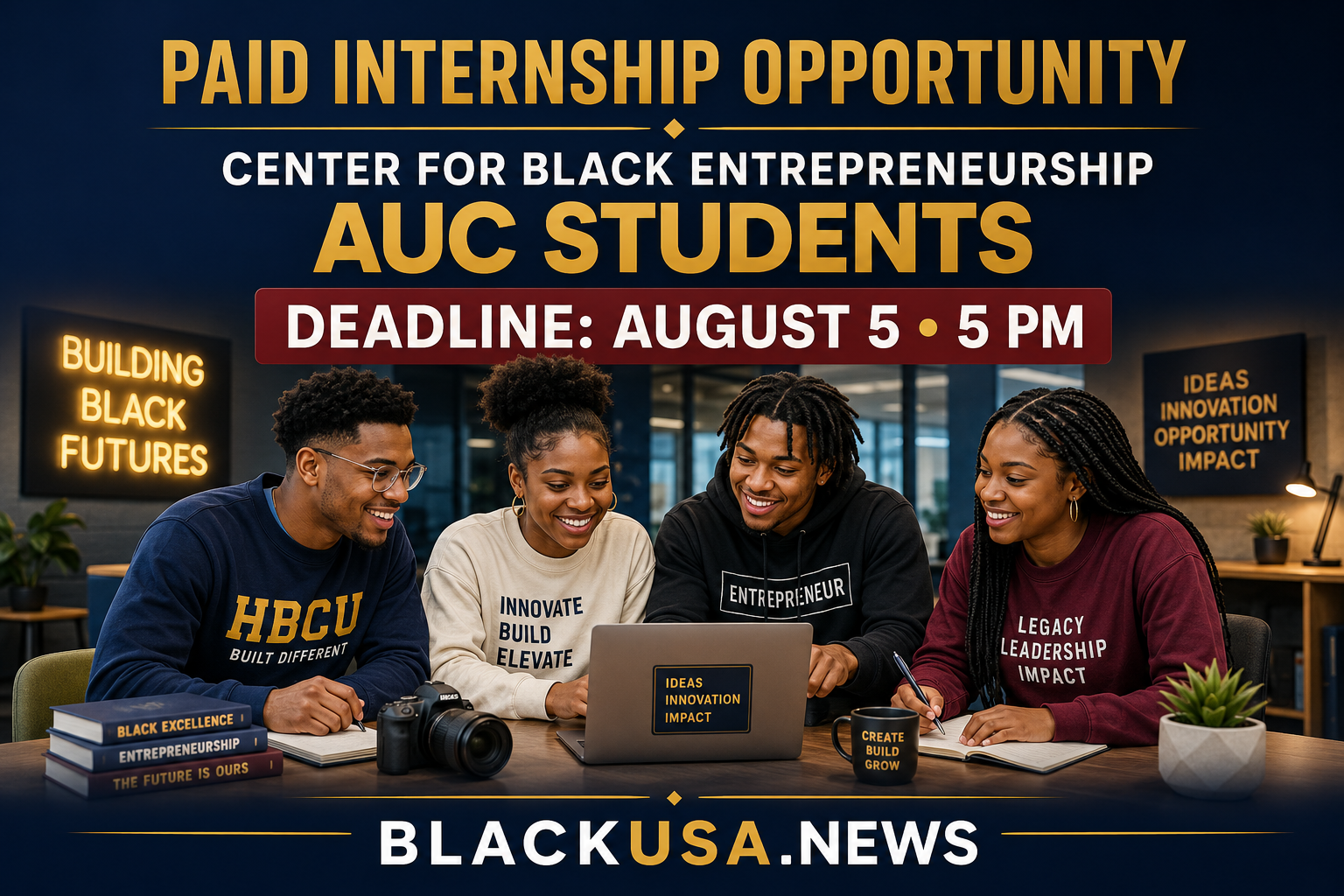
(ATLANTA — August 3, 2026) — The Center for Black Entrepreneurship is accepting applications for its 2026–2027 Paid Internship Program, offering students across the Atlanta University Center an opportunity to gain hands-on professional experience while supporting programs designed to empower entrepreneurs.
The internship program is open to eligible students attending Spelman College, Morehouse College, Clark Atlanta University and Morris Brown College.
Available internship opportunities include:
- Marketing and social media
- Photography and videography
- Administrative operations
Selected interns will work alongside Center for Black Entrepreneurship staff and industry partners while gaining real-world experience in entrepreneurship, marketing, event management, operations and program administration. Interns will also have opportunities to strengthen their professional skills, expand their networks and contribute to events and initiatives serving the AUC community.
Who Is Eligible?
Applicants must:
- Be a sophomore, junior or senior
- Be currently enrolled at Spelman College, Morehouse College, Clark Atlanta University or Morris Brown College
- Maintain a minimum cumulative GPA of 2.75
- Attend mandatory team meetings on Mondays at 6:30 p.m. and Thursdays beginning at 5 p.m.
- Be available for occasional evening and weekend events
- Commit approximately 10 to 15 hours per week throughout the academic year
Required Application Materials
Students should be prepared to submit:
- A résumé
- A professional biography of at least 200 words
- An official or unofficial transcript
- One letter of recommendation
- A portfolio or work samples for photography and videography or marketing and social media positions
The deadline to apply is Wednesday, August 5, 2026, at 5 p.m.
With the deadline quickly approaching, interested and eligible students are encouraged to gather their materials and submit their applications as soon as possible.
The Center for Black Entrepreneurship is a collaborative initiative serving the Atlanta University Center and working to strengthen the pipeline of Black entrepreneurs through education, mentorship, professional development and access to entrepreneurial resources.
APPLY

(RICHMOND – February 23, 2026) – Black-owned newspapers are disappearing before our eyes.
Historic institutions that once carried our stories, defended our dignity, and documented our victories are folding across the country. Newsrooms that anchored neighborhoods for generations are going quiet. Seniors who relied on the printed word are now being forced into a digital world that did not wait for them.
This is not just a Black problem. It is not even just an American problem. It is global.
Technology disrupted everything.
We once used pagers. Then cell phones replaced them. House phones became optional. Now news lives in the palm of your hand. A single influencer with a smartphone can reach more people in seconds than a newsroom once could in a week.
The game changed.
Years ago, The Baltimore Sun recruited me to blog for them. Soon after, their reporters were required to shoot video on their phones. The thing is — I had already been doing that. Innovation wasn’t new to us. We were early.
But disruption leaves casualties.
When a Black newspaper closes, something more than a business disappears. Institutional memory vanishes. Accountability weakens. Community narrative shifts into someone else’s hands.
That void is dangerous.
That is why we built BlackUSA.News.
Not as nostalgia.
Not as resistance to change.
But as adaptation with intention.
I have worked in the Black Press since 1994. I have seen what happens when we control our story — and what happens when we don’t.
BlackUSA.News is our answer to this moment.
We are not watching the Black Press die.
We are rebuilding it — digitally, nationally, unapologetically.
And we welcome all who are ready to build with us.

Deadline Aug. 5: Center for Black Entrepreneurship Opens Paid Internship Program for AUC Students

N.C. A&T to Host 100th Greatest Homecoming on Earth Virtual News Conference on Friday

BlackUSA.News Unveils New National Platform Connecting Readers to America’s Leading Black Media

Gospel Legend Calvin Bridges Celebrates 50 Years of ‘I Can Go to God in Prayer,’ a Song That Helped Shape Black Gospel Music

Crawford Family Donates $2 Million to Spelman and Morehouse to Expand Opportunity for HBCU Students

Remember Who You Are: The Indigenous Series

Remember Who You Are: The Indigenous Series 📱

Indigenous Series: Reclaiming Our Legacy

Indigenous Series: Reclaiming Our Legacy 📱

Indigenous Series: Save Our Legacy 📱
-

 News1 year ago
Voices of West Tampa: District 5 Special Election Forum, Aug. 27th
-

 HBCU1 year ago
Lincoln University’s Vice President and General Counsel Venus D. Boston Appointed to National Legal Board
-

 Videos2 years ago
New Life Recovery Program: Rev. Terry Thornton
-

 Videos2 years ago
New Life Recovery Show: Bro. Curtis Warren, Brothers Helping Brothers
-

 Videos2 years ago
Emmy-nominated Doni Glover Show: Serial Entrepreneur Lance London
-

 Videos3 years ago
Emmy-nominated Doni Glover Show: NC's Dr. Eric Kelly
-

 Videos2 years ago
Emmy-nominated Doni Glover Show: Barry Williams for Balto. Co. Exec
-

 Videos2 years ago
Emmy-nominated Doni Glover Show: Pastor Robert Turner, Empowerment Temple